Lesson 1.4 · Multiplying and dividing more than two numbers
Hua's Classroom for Shanghai Maths — One Lesson One Exercise (English edition, pages 8–9).
Lesson Alignment
How this Shanghai Maths lesson connects to learning goals, Common Core, and Eureka Math.
Learning Objectives
Students will be able to:
- 01Calculate expressions with more than two × or ÷ factors (left to right; ×÷ before +−). (Question 1)
- 02Combine two number sentences into one mixed sentence with parentheses. (Question 2)
- 03Compare expressions using >, <, or =. (Question 3)
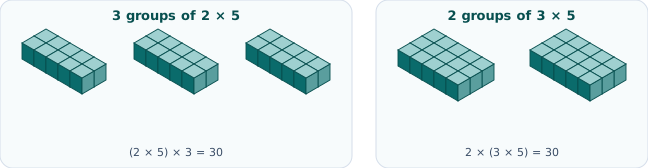
- 04Interpret 3-D / array models as different groupings of the same product. (Question 4)
- 05Solve multi-step word problems that chain multiplication or division. (Question 5, 6)
Common Core Standards
| Code | Standard (focus for this lesson) |
|---|---|
| 3.OA.B.5 | Apply properties of operations as strategies to multiply and divide. (Question 2, 4) |
| 3.OA.A.3 | Use multiplication and division within 100 to solve word problems. (Question 5) |
| 3.OA.D.8 | Solve two-step word problems using the four operations. (Question 5, 6) |
| 3.OA.A.1 | Interpret products of whole numbers. (Question 4) |
| 3.MD.C.7 (related) | Relate area to multiplication; arrays. (Question 4) |
Eureka Math Correspondence
| Shanghai Maths 1.4 | Focus | Eureka Math (corresponding) |
|---|---|---|
| Question 1 | Mental ×÷ chains & mixed ops | G3 M1 / M3 fluency |
| Question 2 | Combine sentences with parentheses | G3 M1 properties; parentheses language |
| Question 3 | Compare expressions | G3 M1 relating multiplication & addition |
| Question 4 | Different groupings of the same product | G3 M1 Topic C–D associative property; arrays |
| Questions 5–6 | Multiplicative word problems / combinations | G3 M1 / M3 application |
Core Concepts
Multiplying and dividing more than two numbers — order, parentheses, and regrouping.
Order of Operations
| Example | Think | Answer |
|---|---|---|
| $8 \times 9 + 8$ | $72 + 8$ | $80$ |
| $45 - 25 \div 5$ | $45 - 5$ | $40$ |
| $8 \times 5 \times 4$ | $40 \times 4$ | $160$ |
| $60 \div 2 \div 3$ | $30 \div 3$ | $10$ |
Combining Two Number Sentences
Replace the first result with the first calculation in parentheses:
Associative Property of Multiplication
Grouping can change; the product stays the same. Useful for “pack boxes into bigger boxes” problems.
Cube / Array Models
The same block of $30$ unit cubes can be seen as different groupings:
- $3$ groups of $2 \times 5$: $(2 \times 5) \times 3 = 30$
- $2$ groups of $3 \times 5$: $2 \times (3 \times 5) = 30$
Key Terms & Definitions (Reference)
Quick glossary for Lesson 1.4 language.
| Term | Definition |
|---|---|
| Mixed number sentence | An equation that uses more than one operation. |
| Parentheses ( ) | Show which part to calculate first (or replace a prior result). |
| Associative property | $(a \times b) \times c = a \times (b \times c)$. |
| Factor / Product | Numbers multiplied / the result. |
| Equal groups | Same number in each group; basis for × and ÷ stories. |
Key Answers
Quick reference for this lesson’s exercise answers.
1. $80$, $12$, $14$, $40$;\; $100$, $0$, $160$, $10$;\; $500$, $660$, $1000$, $540$.
2. $(2\times4)\times3=24$;\; $(63\div7)\div3=3$;\; $(5\times6)\div3=10$.
3. $=$;\; $<$;\; $>$.
4. $3$ groups of $2\times5$: $(2\times5)\times3=30$;\; $2$ groups of $3\times5$: $2\times(3\times5)=30$;\; $3$ groups of $1\times10$: $3\times(10\times1)=30$.
5. $40$ cakes;\; $12$ years old;\; $252$ households.
6. $45$ matches total;\; $45\div9=5$ per field.